
Short answer
- What it means: HIPAA-compliant data annotation means labeling protected health information (PHI) under the same safeguards HIPAA imposes on any covered entity or business associate — a signed Business Associate Agreement (BAA), the minimum-necessary principle, access controls and audit logs on every annotation action, encryption in transit and at rest, and a documented breach-notification path.
- The vendor need not be American: it needs to be contractually a Business Associate and able to prove these controls under audit.
- The test: if your annotation partner cannot produce a BAA and an access-logged, de-identification-aware workflow, the labels are not HIPAA-compliant no matter how accurate they are.
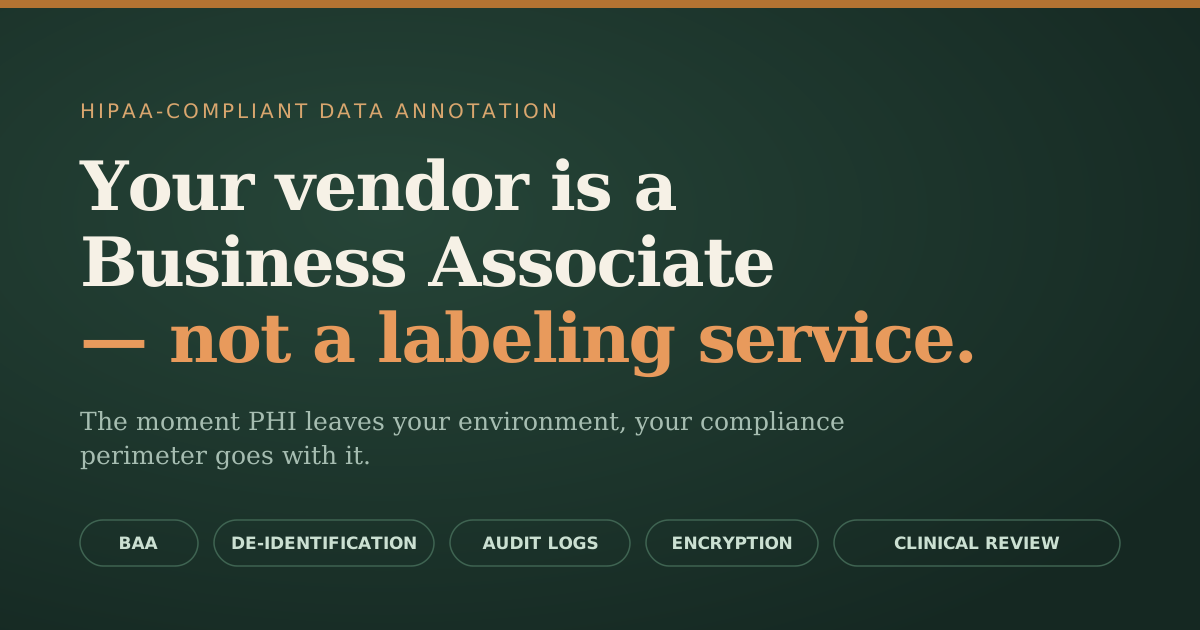
I'll say the uncomfortable part first, because most outsourcing conversations skip it: in healthcare AI, your annotation vendor is not a "labeling service." Under HIPAA they are a Business Associate, and the moment a radiology study or a clinical note leaves your environment to be labeled, your compliance perimeter extends to wherever that data lands. That is the lens healthcare teams should buy through — and almost nobody does.
This came into focus for me again this week. Rad AI went live with Yale New Haven Health across sixteen-plus imaging sites — exactly the kind of deployment where the model is only as trustworthy as the labeled data underneath it, and the data is only usable if the labeling pipeline is HIPAA-defensible end to end. The teams that win these deployments are not the ones with the cheapest per-label rate. They are the ones who can hand an auditor a clean answer.
So here is the checklist I'd run before signing anything.
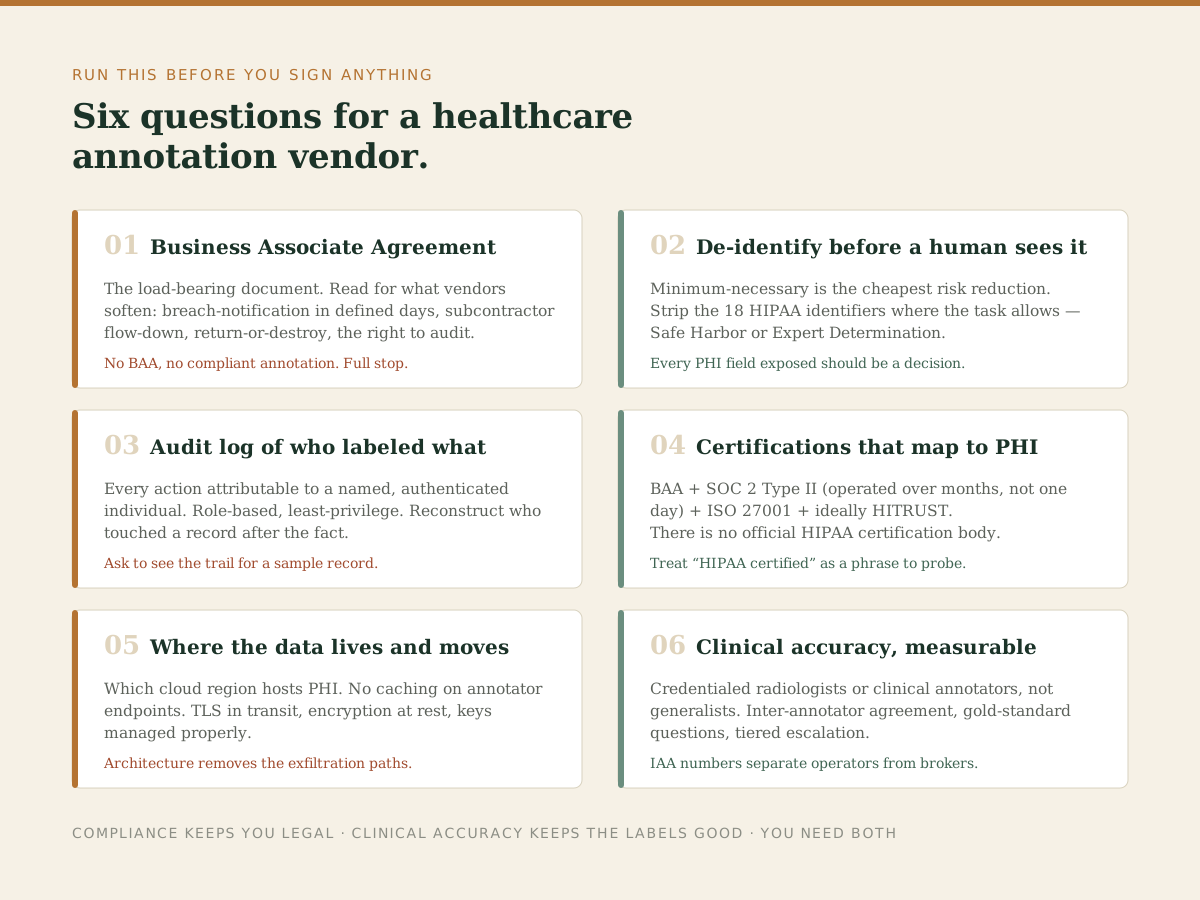
1. Is there an actual Business Associate Agreement — and does it have teeth?
The BAA is the load-bearing document. It is what legally converts a third-party labeler into a Business Associate and binds them to HIPAA's Security and Privacy Rules. No BAA, no compliant annotation. Full stop.
But a BAA that merely exists is not the same as a BAA that protects you. Read for the parts vendors quietly soften: breach-notification timelines (you want a defined number of days, not "promptly"), subcontractor flow-down (every downstream annotator and tool must be bound by the same terms), data-return-or-destruction obligations at contract end, and the right to audit. If the vendor uses offshore annotation pods — many do, and that is fine — the BAA and its flow-down clauses are what make offshore labeling compliant rather than a liability.
2. Is PHI de-identified or minimized before a human ever sees it?
HIPAA's minimum-necessary principle is the cheapest risk reduction available, and it is routinely ignored. Ask a blunt question: does your annotator need the patient's name, MRN, and date of birth to draw a bounding box around a lung nodule? Almost always, no.
A serious pipeline strips or masks the 18 HIPAA identifiers before annotation wherever the labeling task allows it — burned-in DICOM metadata, accession numbers, face data in head CT/MRI, free-text PHI in clinical notes. Two routes qualify under HIPAA's de-identification standard: Safe Harbor (remove all 18 identifiers) or Expert Determination (a qualified statistician certifies re-identification risk is very small). If a task genuinely needs identifiers, that is where the BAA and access controls carry the weight. The point is intentionality: every field of PHI exposed to a human should be a decision, not an accident.
3. Can the vendor show you an audit log of who labeled what, when?
This is the question that separates marketing from process. HIPAA's Security Rule requires audit controls — the ability to record and examine access to ePHI. In an annotation context that means: every annotator action is attributable to a named, authenticated individual; access is role-based and least-privilege; and you can reconstruct, after the fact, exactly who touched a given record.
Ask to see the audit trail for a sample record in their demo environment. A vendor with real controls will show you. A vendor selling you a spreadsheet of labels and a confident smile will change the subject. That tell is worth more than any certification logo.
4. Do the certifications actually map to PHI handling?
Certifications are useful shorthand, but only if you read what they cover. The relevant set for healthcare annotation:
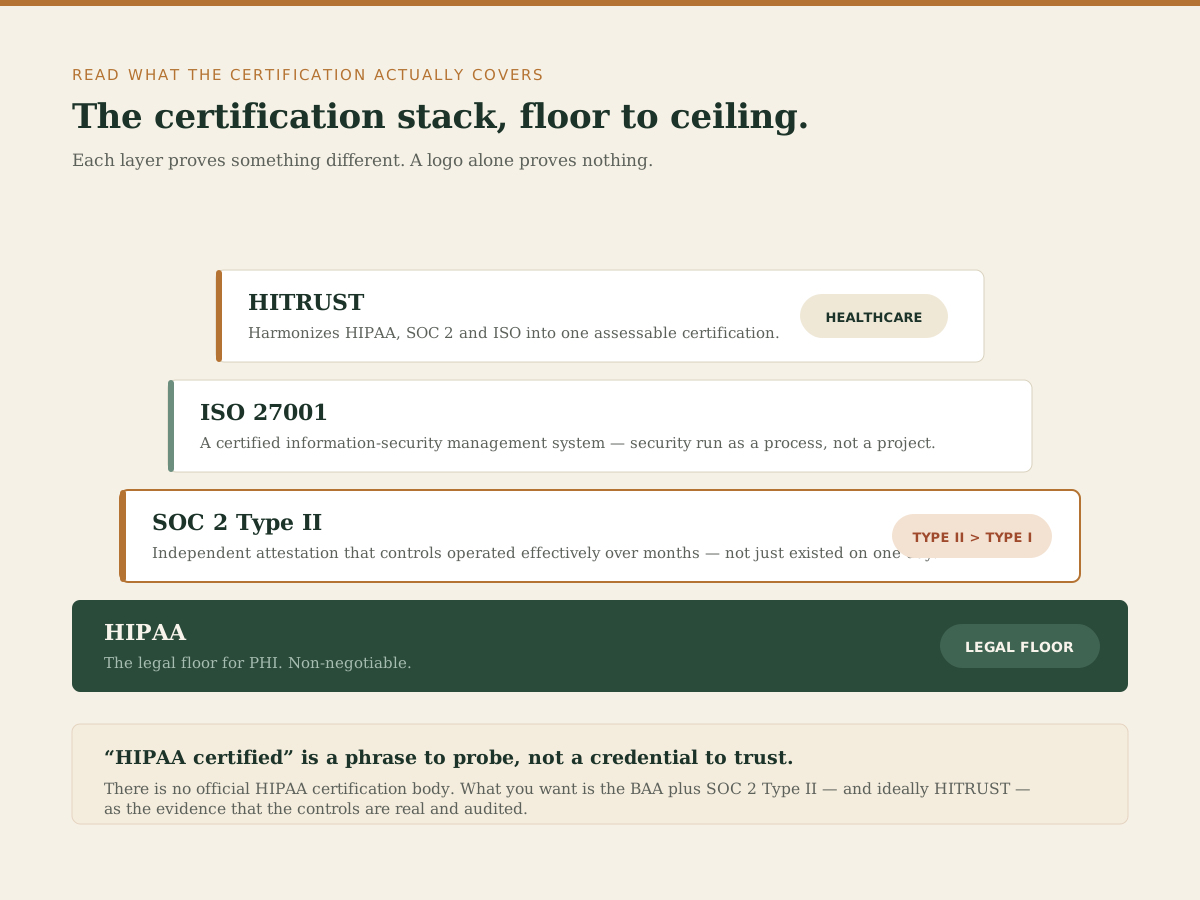
- HIPAA — the legal floor for PHI. Non-negotiable.
- SOC 2 Type II — independent attestation that security controls operated effectively over a period (months), not just existed on one day. Type II matters more than Type I here.
- ISO 27001 — a certified information-security management system; evidence the vendor runs security as a process, not a project.
- HITRUST — a healthcare-specific framework that harmonizes HIPAA, SOC 2, and ISO into one assessable certification; increasingly asked for by US health systems.
A vendor claiming "HIPAA certified" with nothing behind it should raise a flag — there is no official HIPAA certification body, so the phrase alone means little. What you want is the BAA plus SOC 2 Type II (and ideally HITRUST) as the evidence that the controls are real and audited.
5. Where does the data physically live and move?
Data residency is not strictly a HIPAA requirement — HIPAA does not mandate US-only storage — but it is increasingly a procurement and contractual one, especially as US health systems tighten vendor reviews and as cross-border work intersects with other regimes. Get specific answers: which cloud region hosts the PHI during annotation, whether any data is cached on annotator endpoints (it should not be — annotation should happen in a controlled, no-local-download environment), and how data is transmitted (TLS in transit, encryption at rest, keys managed properly).
The strongest offshore models — and I'll be direct, because we run one — keep PHI inside a controlled cloud environment, give annotators access through a locked-down interface with no ability to export, and log every action. Geography stops being the risk when the architecture removes the exfiltration paths.
6. Is clinical accuracy backed by credentialed reviewers and measurable agreement?
Compliance keeps you legal; it does not make the labels good. Healthcare annotation has a second bar: the labels have to be clinically correct, and that requires the right humans. For imaging, that means credentialed radiologists or trained clinical annotators in the loop, not generalists. For clinical NLP, it means reviewers who understand the terminology.
The way you prove quality is measurable, not anecdotal: inter-annotator agreement (do two qualified reviewers agree?), gold-standard questions seeded into the workflow to catch drift, and a tiered review structure where complex cases escalate to senior clinical reviewers. When a vendor can show you their IAA numbers and their gold-question pass rates, you are talking to an operator. When they can't, you are talking to a broker.
Why this matters more in 2026, not less
Two forces are pushing this from "nice to have" to "table stakes." First, healthcare AI is moving from pilots into production deployments where regulators, hospital compliance teams, and ultimately patients are in the loop — the Rad AI / Yale New Haven type of rollout is the new normal, not the exception. Second, Gartner's projection that a large share of AI projects get abandoned for data-quality reasons hits healthcare hardest, where a bad label isn't a degraded metric — it's a clinical risk.
The teams that treat annotation as a compliance-grade function, not a commodity, are the ones whose models survive contact with an auditor and a clinician. That is the entire thesis behind how we built LabelFort: compliance and clinical quality as the product, not the afterthought.
Compliance posture
Five frameworks. One annotation backbone that passes Legal, Security, and Procurement.
FAQ
Q. Does HIPAA-compliant data annotation have to be done in the United States?
No. HIPAA does not require US-based storage or labeling. It requires that whoever handles PHI is a contractually bound Business Associate operating under HIPAA's safeguards. Offshore annotation is compliant when there is a valid BAA with subcontractor flow-down, a controlled no-export environment, encryption, and audit logging.
Q. Is a Business Associate Agreement enough on its own?
The BAA is necessary but not sufficient. It is the legal binding; the technical controls (de-identification, access logs, encryption, least-privilege access) are what make the BAA's promises real. Auditors look for both.
Q. What's the difference between SOC 2 Type I and Type II for an annotation vendor?
Type I attests that controls were designed appropriately at a point in time. Type II attests that they operated effectively over a period (typically 3–12 months). For PHI work, insist on Type II.
Q. Can you de-identify data and still annotate it usefully?
Yes, for most tasks. You strip the identifiers that aren't needed for the labeling decision while preserving the clinical content being labeled. Where a task genuinely needs identifiers, the BAA and access controls govern that exposure.
Q. What certifications should I ask a healthcare annotation vendor for?
A signed BAA, SOC 2 Type II, ISO 27001, and ideally HITRUST. Treat "HIPAA certified" as a phrase to probe, not a credential to trust.
Next step
Run this checklist against your annotation vendor.
LabelFort was built so compliance and clinical quality are the product, not the afterthought — BAA-backed, access-logged, de-identification-aware, with credentialed clinical review. Bring one of your datasets to a Compliance Review and we will show you what HIPAA-defensible labeling looks like on your own data.