
P5 Frontier · Data Strategy · LabelFort
Synthetic data vs human labeled data in 2026: when each wins (and why the answer is hybrid)
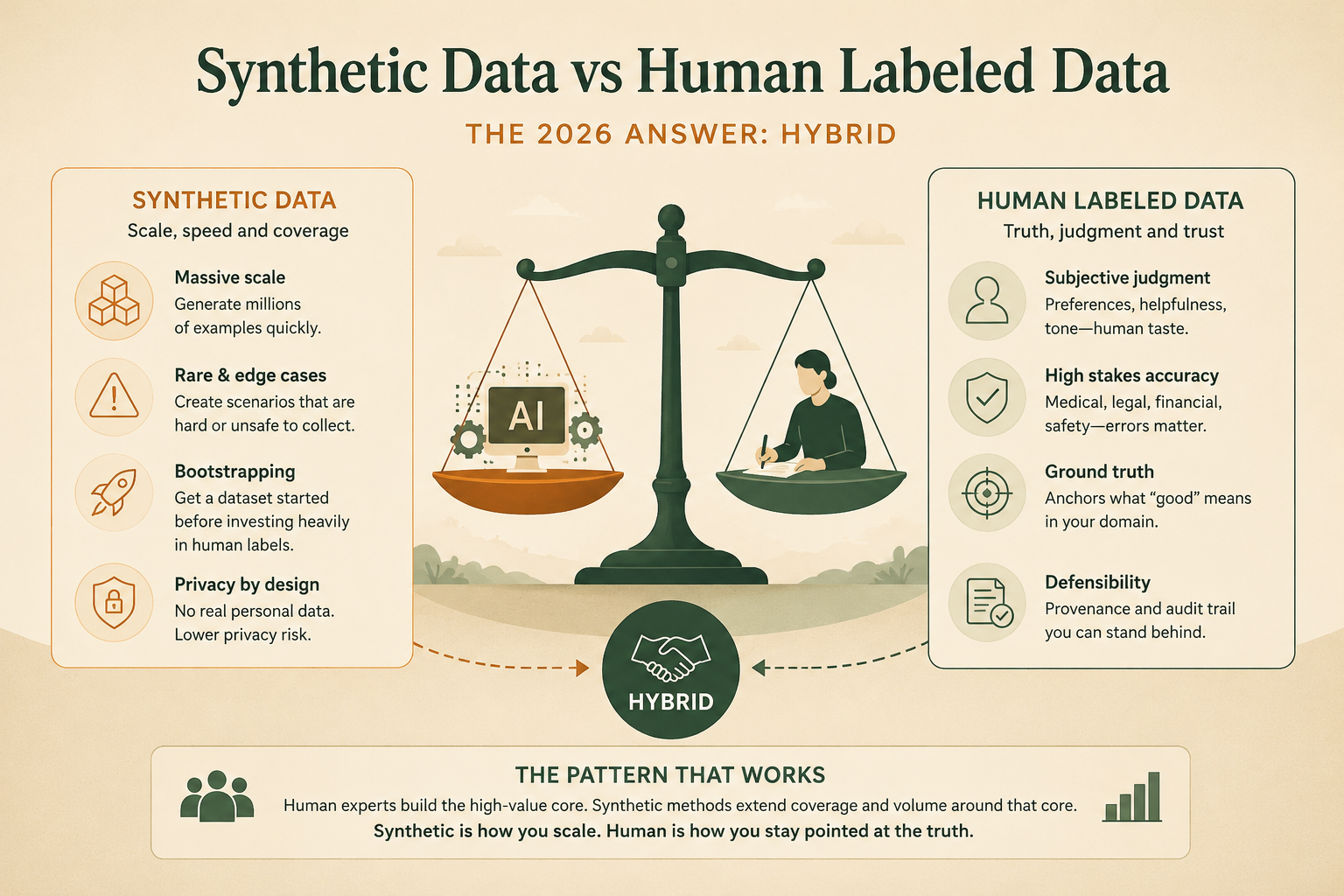
"Can't we just generate the training data?" is the most common question in AI teams this year. The honest 2026 answer: synthetic data is a powerful multiplier, not a replacement, and the teams getting it right run a hybrid. Here is the decision framework.
Why the question is hotter than ever
Generating data with a frontier model is cheap and fast. A human preference judgment can cost on the order of $1 to $10 or more per item; AI generated feedback can cost under a cent. When the cost gap is 100x, every team is tempted to go synthetic first.
At the same time, demand for human data keeps climbing. The AI data labeling market is estimated at $2.32 billion in 2026 and projected to reach $6.53 billion by 2031. Both things are true at once, which is exactly why the topic is confusing.
Where synthetic data wins
- Coverage and volume. Generating large quantities to cover the easy middle of a distribution, fast.
- Rare events and edge cases. Synthesizing scenarios that are hard or unsafe to collect in the real world.
- Bootstrapping. Getting a v0 dataset moving before investing in expensive human labels.
- Privacy. Producing data that contains no real personal information.
Where human labeled data wins
- Subjective judgment. Preferences, helpfulness, tone, deciding which answer is better. Taste is human.
- High stakes correctness. Medical, legal, financial, and safety domains, where a wrong label has real consequences.
- Ground truth. Anchoring what good actually means in your domain, so the rest of the pipeline has a reference point.
- Defensibility. When you need provenance and accountability you can show an auditor.
The trap
Synthetic only pipelines plateau. The highest risk place to lean fully synthetic is RLHF and preference data. If a model's reward signal is generated by another model, it can learn to optimize for superficial patterns rather than genuine quality, and the errors compound quietly. A pipeline with no human anchor tends to plateau, then drift, because nothing is pulling it back toward real world good.
The 2026 consensus: hybrid
The pattern that works: human experts produce the high value core (edge cases, preferences, rubrics, gold standards) and synthetic methods extend coverage and volume around that core. Synthetic is how you scale; human is how you stay pointed at the truth.
The ratio depends on stakes. A low risk consumer classifier can be mostly synthetic; a clinical or safety model needs a substantial human verified core.
A simple way to decide
The two question test
For each dataset, ask: how subjective is the judgment, and how costly is a wrong label?
High on either axis: invest in human labels, with measured agreement and provenance. Low on both: synthetic can carry more of the load. Most real systems land in the middle, which is why hybrid wins.
Common questions
Is synthetic data replacing human labeled data?
Can you train a model entirely on synthetic data?
What ratio of synthetic to human data should a team use?
Next step
Keep synthetic scale anchored to human ground truth
LabelFort, Predusk's data annotation platform, sits on the human side of that line: the expert core, with the agreement metrics and audit trail that make a dataset defensible. Pair it with synthetic generation for coverage, and you get both scale and trust.
Book a compliance review